
Why a Profitable Strategy Can Fail a Prop Firm Evaluation
A profitable backtest can still fail a prop firm evaluation because the final profit does not show whether the account broke a rule along the way. An open loss may touch the drawdown floor before a trade recovers. One unusually strong day may leave the strategy short of a consistency requirement. Trading costs may remove the margin that made the result look comfortable.
If you are choosing a strategy for a challenge, the useful question is: would this sequence of trades have reached the target without breaking this account’s rules? Start there before paying another evaluation fee.
This guide works through two constructed examples and a practical review checklist. They illustrate the calculations; they are not measured strategy results, a firm recommendation or a forecast of passing. Official rule sources were checked on 12 October 2026.
Start with the exact account’s rules
A firm name is not enough to configure a test. Record the account product, size and stage. An evaluation and a funded account can use different loss limits or payout conditions, even at the same firm. Save the source link and the date you checked it.
Build a short rule sheet before looking at the strategy’s returns:
| Rule | What to record |
|---|---|
| Maximum loss | Starting floor; static or trailing; when it moves; whether it locks; whether open P&L counts. |
| Daily loss | Calculation basis, reset time and timezone, plus the treatment of commissions and open positions. |
| Profit and consistency | Target, best-day formula, measurement window and what happens if the threshold is exceeded. |
| Trading days and restrictions | Minimum or maximum days, position limits, news restrictions and overnight or weekend rules. |
These details determine what the test must measure. Tradelyze’s guide to prop firm rules and backtest metrics explains how to connect the rule sheet to a report.
A later recovery cannot undo an earlier breach
Imagine a hypothetical account starting at $50,000 with a fixed loss floor of $48,000. For this example, touching the floor makes the evaluation ineligible to pass. The unrestricted strategy simulation follows this path:
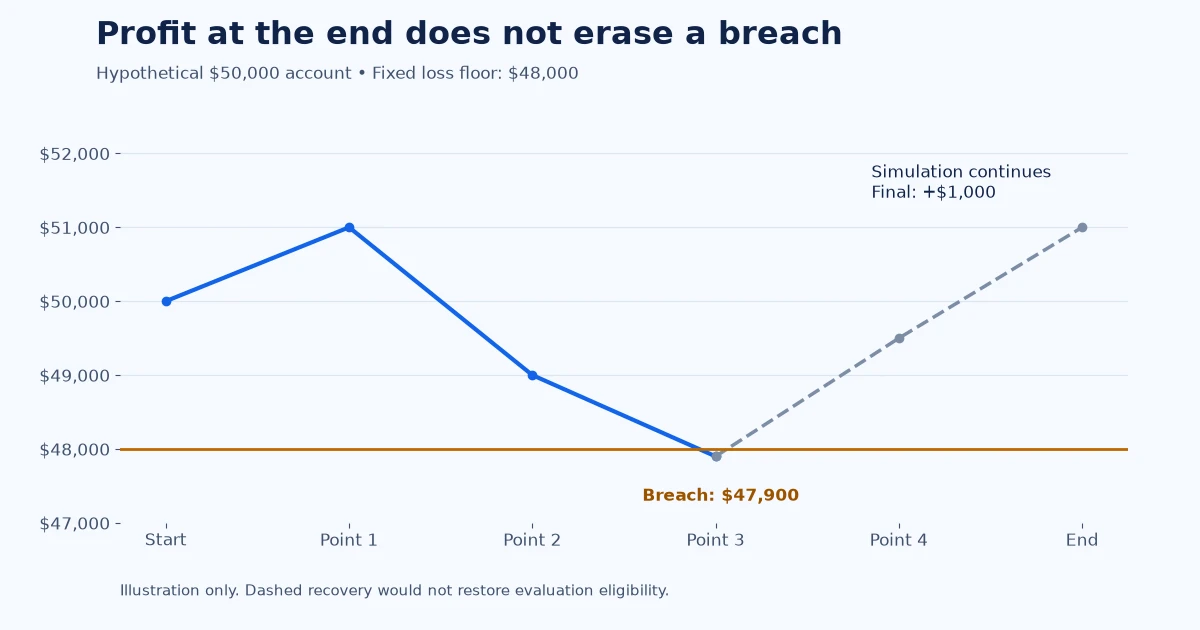
The simulation ends at $51,000, a $1,000 gain. But it first drops to $47,900. A profit figure at the end cannot make that earlier rule breach disappear. A rule-aware review stops counting that path as a successful evaluation at the breach.
Now consider an open trade that falls through the floor and recovers before closing. A report built only from closed trades can miss that event entirely. A smooth closed-trade balance curve is therefore incomplete evidence when the firm monitors equity during a trade.
For a real example of the distinction, Topstep states that its Maximum Loss Limit updates from end-of-day balances but is monitored during the session, including unrealized P&L. Its trailing floor never moves down and eventually locks at the starting balance. Topstep’s official Maximum Loss Limit explanation is the source for those details; our fixed-floor illustration above is not a model of Topstep’s rule.
Separate two questions: when does the floor move? and when can you breach it? “End of day” in the first answer does not necessarily mean losses are checked only at the close. See how trailing drawdown works before selecting a drawdown setting.
A big winning day can leave you short of consistency
A second strategy makes money without breaching the loss floor. It can still fall short of a consistency condition if too much profit comes from one day.
Use this hypothetical five-day ledger. The figures are daily net results after assumed trading costs:
| Day | Net result |
|---|---|
| 1 | +$1,200 |
| 2 | −$400 |
| 3 | +$300 |
| 4 | −$200 |
| 5 | +$100 |
| Total | +$1,000 |
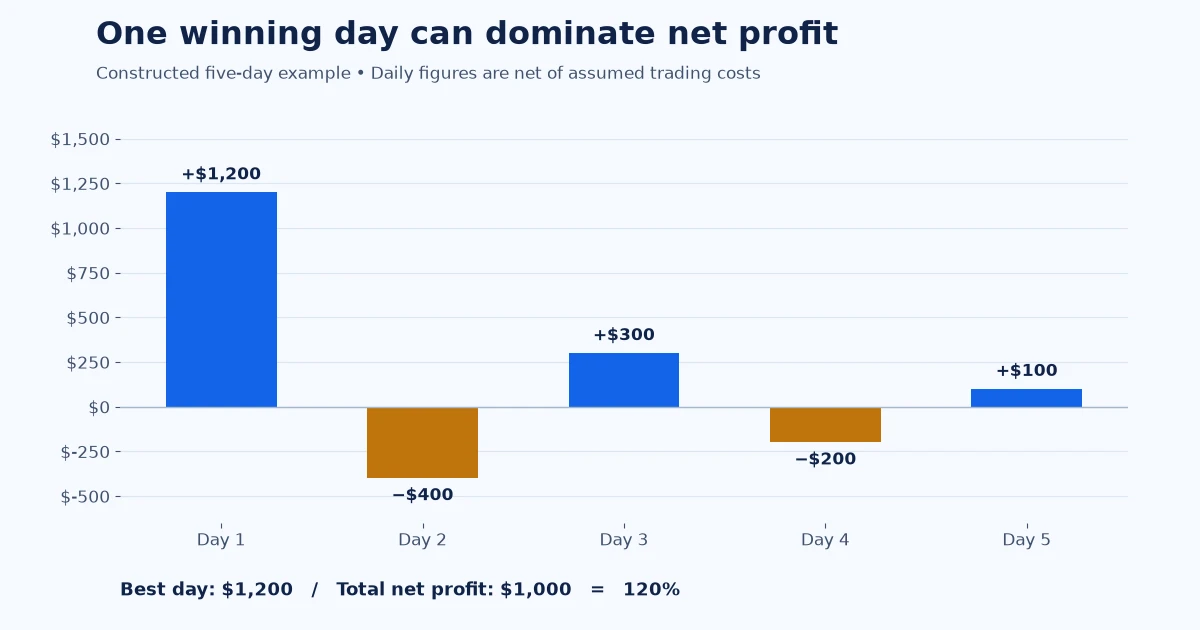
If the rule divides the best day by total net profit, the calculation is $1,200 ÷ $1,000 = 120%. A value above 100% is possible because losing days reduce the denominator.
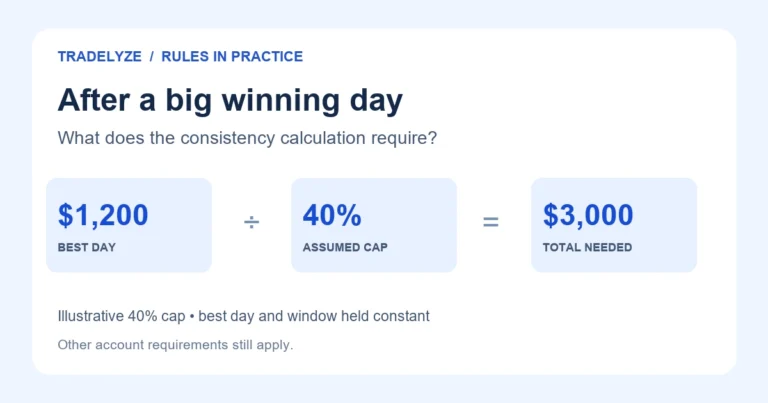
Suppose our hypothetical rule requires that share to be no more than 40%. The required total net profit would be $1,200 ÷ 0.40 = $3,000. That is another $2,000 net, provided the best day stays at $1,200 and the calculation window does not reset. It does not show that the extra profit is achievable. A new, larger best day would change the calculation.
The 40% figure is an assumption for this example, not a universal evaluation limit. Topstep, for instance, currently distinguishes a 55% Trading Combine consistency target from the 40% objective on its Express Funded Account Consistency payout path. In the Combine, exceeding the best-day threshold increases the required profit target; it is not the same event as breaching the loss limit. Check Topstep’s current consistency rules for the account and stage you are considering.
Also check the denominator. “Total net profit,” “profit target” and “positive days’ profit” describe different calculations. Copying a percentage while ignoring its definition can produce a reassuring but irrelevant result.
Check the costs behind the profit figure
Consider a separate hypothetical test showing $1,200 of gross profit across 80 round-trip trades. At an assumed $6 per round trip, commissions and fees total $480. The remaining profit is $720 before any additional slippage omitted from the model.
Those are illustrative inputs, not a broker’s quoted rate. Use the actual instrument, contract quantity and fee schedule for your test. If the report already includes a cost, do not subtract it again. Evaluation subscriptions and reset fees belong in a separate budget unless the firm’s rules explicitly deduct them from trading P&L.
TradingView’s strategy documentation explains that historical orders run through a broker emulator, with assumptions about price movement inside bars. It also documents commission and slippage settings. Review those assumptions when comparing a backtest with a live account: a simulated fill is not a promise that the same order will fill at that price. TradingView’s strategy testing documentation covers the mechanics.
Test an evaluation window, not just the full history
A year of profit can hide a difficult first week. It can also make a single winning day look small relative to a large annual total, even though that day would dominate a short evaluation.
Keep the strategy settings fixed and inspect several start dates. For each window, record the first rule breach, the date the target was reached and whether every required condition was met by then. A window that never reaches the target is not a pass simply because it survives.
Then use data you did not use to choose the settings. If you tune the strategy after seeing that data, it has become part of development; it is no longer an untouched check. The workflow in how to validate a trading strategy connects reproduction, unseen-data testing and forward observation.
Trade-order stress tests can add another perspective. Reordering the same trades preserves their combined profit but can change the loss sequence and drawdown. That helps reveal dependence on a favourable order. It cannot establish a reliable future pass probability or invent market conditions absent from the sample. Read the assumptions in Monte Carlo simulation for trading strategies before interpreting a percentage as a forecast.
What a Tradelyze rule check can—and cannot—tell you
Tradelyze can help compare a strategy’s closed-trade results with configured prop firm rules. The configuration and data limits still matter. Its published documentation says presets are snapshots, rather than rules automatically kept current with a firm’s website.
The same documentation identifies several limits: closed trades do not capture losses inside an open position; consistency uses net profit over the whole backtest; and time limits, news restrictions and weekend-holding conditions are not evaluated. Its trailing checks also keep trailing rather than modelling every firm’s locking mechanism.
Use the custom prop firm rules guide to understand those boundaries. A “Qualifies” result applies to the checks performed. It does not certify every term of the account or guarantee a future pass.
Your review before paying for a challenge
- Save the current rules. Record the exact product and stage, source URLs and review date. Resolve unclear wording with the firm.
- Match the test to the intended account. Check starting capital, instrument, contract size, costs and timezone. Review position sizing for prop firm challenges if the backtest uses a different size.
- Inspect the path. Locate the smallest distance to each loss floor. Mark intratrade equity as unknown wherever the data cannot show it.
- Review several fixed-setting windows. Include unseen data and losing periods. Record failures and timeouts alongside successful windows.
- Observe forward behaviour. Compare signals, fills, costs and rule calculations with the test before treating the strategy as ready for an evaluation.
Keep the output to one page: what matched, what failed and what the test could not establish. A strategy with an unresolved equity-data gap needs more evidence, even if its headline profit looks attractive.
Common questions
Can a profitable strategy fail a prop firm evaluation?
Yes. It can breach a loss limit before recovering, miss the profit target within the required window or fail another account condition. Final profitability alone does not establish a pass.
Does exceeding a consistency threshold always fail the account?
No. The consequence depends on the product’s rules. It may increase the profit required or delay eligibility. Check the exact wording instead of treating every consistency flag as an account-ending breach.
Is maximum drawdown from closed trades enough?
Not when the firm monitors open-position equity. A trade can cross a loss floor and recover before closing. Closed-trade data alone cannot rule that out.
Does a rule-check pass guarantee a future payout?
No. It only describes the tested data and the rules actually modelled. Future trading, execution, untested restrictions and the firm’s account requirements still affect the outcome.
Methodology: All numerical illustrations in this article are constructed examples. Firm-rule references were reviewed on 12 October 2026 and may change. Read Tradelyze’s editorial policy and methodology for its approach to evidence and product limitations.
One Comment