
Prop Firm Consistency Rule After a Big Winning Day
A big winning day can leave you profitable but still outside your prop firm’s consistency rule. The next step is to calculate how much eligible profit your best day requires, using the formula and measurement window for your account. A larger balance alone doesn’t tell you whether you qualify.
This worked guide follows a five-day ledger, calculates the remaining profit under a hypothetical 40% cap, and shows what changes after another loss or a new best day. For the definitions behind the calculation, see the Tradelyze prop firm consistency rule guide. Current firm-specific updates are dated below.
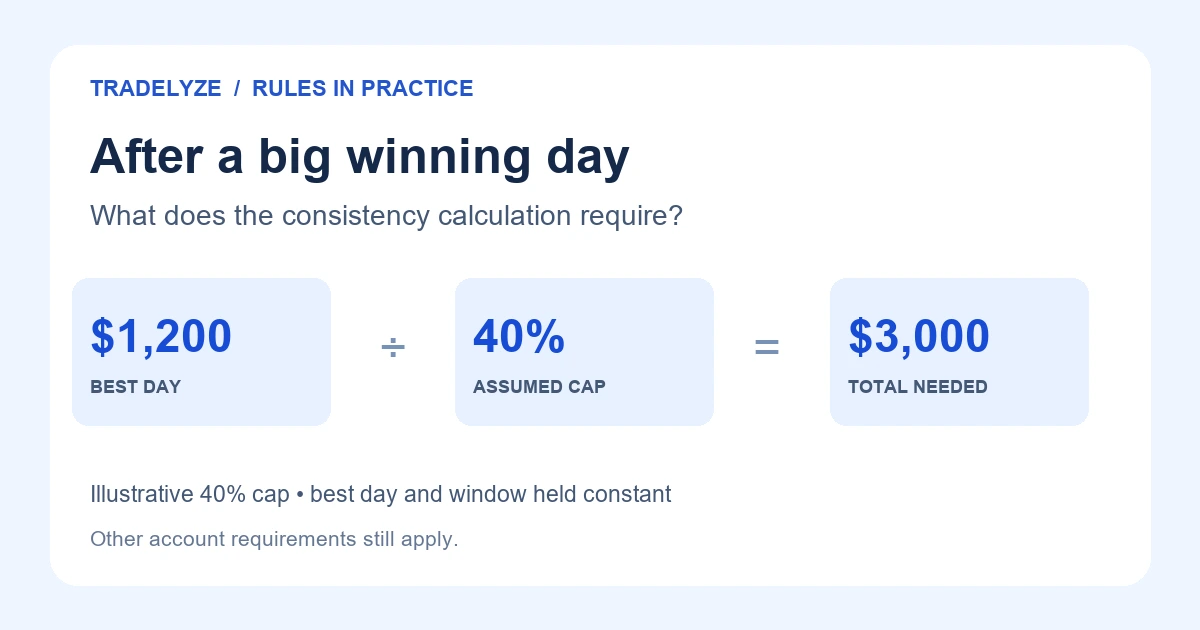
Quick answer: For a rule based on total net profit, divide your best day’s net profit by the allowed percentage as a decimal. A $1,200 best day under an inclusive 40% cap requires at least $3,000 total net profit. That result holds only while the best day, rule and measurement window stay unchanged.
Start with the rule on your account
Before calculating anything, record the firm, product, account stage and applicable order date. An evaluation target and a payout condition can use different percentages, even at the same firm. The best day profit rule may also count all daily results or only profitable days.
- Numerator: Is the best day based on the firm’s daily net P&L, with the applicable costs included?
- Denominator: Does the rule use total net profit, positive-days profit or a stated target?
- Window: When does the evaluation or payout period start, and what resets it?
- Day boundary: Which session and timezone define a trading day?
- Threshold: Does the rule allow equality, or must the percentage be strictly below the limit?
Use the firm’s account statement and rule page together. If your export groups trades by local midnight but the firm groups them by its trading session, the largest day can change before you even reach the division.
A consistency rule calculation with losing days
Here is a constructed example, not an actual account or trading recommendation. All five entries are daily net P&L after assumed trading costs, grouped into the hypothetical firm’s trading days. The window begins immediately before Day 1, with no earlier profit carried into it.
| Trading day | Daily net P&L | Cumulative net profit |
|---|---|---|
| Day 1 | +$1,200 | $1,200 |
| Day 2 | −$400 | $800 |
| Day 3 | +$300 | $1,100 |
| Day 4 | −$200 | $900 |
| Day 5 | +$100 | $1,000 |
The best day is $1,200, but total net profit is only $1,000. Therefore:
Best-day share = $1,200 ÷ $1,000 × 100 = 120%.
A percentage above 100% is possible. It means losses have reduced the total below the largest profitable day. It doesn’t mean the calculation should discard those losses. Under a positive-days-only denominator, this same ledger produces $1,200 ÷ $1,600 = 75%. Those are different rules applied to identical trades.
How much more profit does the big day require?
For an inclusive net-profit cap, let B be the best day, P the current window’s net profit, and c the cap as a decimal. The consistency calculation is:
- Required total net profit = B ÷ c
- Additional net profit needed = max(0, B ÷ c − P)
With a $1,200 best day, $1,000 current profit and a hypothetical 40% cap, the required total is $3,000. The arithmetic gap is $2,000. This is a condition to evaluate, not a daily earnings target or a reason to increase position size.
| Hypothetical inclusive cap | Required total | Gap from $1,000 |
|---|---|---|
| 30% | $4,000 | $3,000 |
| 40% | $3,000 | $2,000 |
| 50% | $2,400 | $1,400 |
If an evaluation also has a separate base profit target, meeting the ratio alone is insufficient. Under this simplified model, the required total is the larger of that base target and B ÷ c. Other conditions, including loss limits and minimum days, still apply.
Keep full precision when checking a boundary. For a rule that requires strictly less than the cap, reaching B ÷ c exactly is not enough. When the denominator is zero or negative, don’t treat the resulting ratio as a pass; use the firm’s treatment of a non-profitable window.
Why the remaining amount can change tomorrow
The $2,000 gap is conditional. Consider three separate continuations of the same five-day ledger, each starting again from $1,000 total profit and a $1,200 best day.
- Four later days each earn $500. Total profit reaches $3,000, and the best day remains $1,200. The ratio becomes 40%, meeting the hypothetical inclusive cap.
- The next day loses $300. Total profit falls to $700. The best day remains $1,200, so the required total stays $3,000 and the gap grows to $2,300.
- The next day earns $2,000. Total profit reaches $3,000, but $2,000 is now the best day. The required total rises to $5,000; the ratio is about 66.7%, leaving another $2,000 gap.
This is why “make another $2,000” is incomplete advice. It describes one arithmetic gap without describing the path. A later win can increase both the denominator and the numerator. A later loss reduces the denominator while leaving a previously locked best day unchanged.
Topstep: evaluation and payout rules are different
Checked on 26 October 2026, Topstep’s consistency documentation distinguishes these two cases:
- Trading Combine: The 55% consistency target can raise the profit target. Topstep now uses best day ÷ 0.55 for the adjusted total. Its example gives a $1,800 best day an approximately $3,273 target. Additional profit on the session that sets the best day increases that day too; the remaining profit must come on a separate trading day. Daily values lock at 3:10 PM CT.
- Express Funded Account, Consistency payout path: The largest single-day net profit must be no more than 40% of total net profit. At least three trading days with a trade each are also required. After a payout request, the new consistency window starts the following trading day.
These are scoped examples, not a complete pass or payout checklist. Confirm the account dashboard and applicable terms before acting. An old 50% Trading Combine example should not replace the current 55% calculation.
FTMO’s October change makes the order date matter
FTMO’s 8 October 2026 CFD trading update says new 1-Step Challenge orders from 12 October at 09:00 use a consistency calculation based on total profit, including losing days. The update states its times in GMT+3. It also applies the replacement to FTMO Accounts (1-Step) merged on or after 12 October.
Earlier orders retain the Best Day Rule based on positive-days profit, including through passing the challenge and receiving subsequent accounts. Check your specific order and any merge history in Account MetriX. This CFD 1-Step update should not be transferred to a different FTMO product.
The practical distinction is the denominator. In our illustrative ledger, counting all days gives 120%; counting only positive days gives 75%. Use the percentage and eligibility conditions displayed for your own account. The earlier Learn guide predates this October change.
A Discipline Score is separate from the account’s consistency rule
FTMO describes its Discipline Score as an informational performance metric, separate from the Trading Objectives. The 82% in the official illustration below is an example score, not the percentage your best day is allowed to contribute or a payout requirement.

Use the calculation without turning it into a recovery trade
After a large day, record the locked best day, eligible window profit, remaining loss room and the rule’s reset event. Recalculate after each completed session. A smaller percentage doesn’t protect an account from a drawdown breach; these are separate checks.
Before changing a strategy to make its daily profit smoother, test what the change removes. A daily profit stop may cut the occasional large wins that offset many small losses. Halving every historical result leaves the best-day ratio unchanged before costs and contract rounding. More trading days also mean more exposure to losses.
The prop firm backtesting checklist covers the wider review. For the loss-limit side, use the intraday versus end-of-day trailing drawdown examples.
Where Tradelyze helps—and what to check separately
According to Tradelyze’s custom prop firm rules documentation, its consistency check compares the best day’s closed-trade profit with net profit over the backtest. Its documented day grouping uses the strategy’s exchange timezone. That makes it useful for examining profit concentration, but it may differ from the firm’s session and account window.
Review a period comparable to the evaluation or payout window, then reconcile its daily ledger with the firm’s definition. A long backtest can dilute one large day with months of unrelated profit. Documented limitations include payout-window resets and the difference between a failed backtest rule and a firm’s delayed eligibility. A passing check doesn’t guarantee a pass or payout.
Frequently asked questions
Does a losing day erase my biggest winning day?
In the net-profit model above, no. A later losing day reduces total profit without changing a previously completed best day. Your best-day share rises as the denominator falls. A specified reset can start a new window, but a loss isn’t itself a reset.
Should I deliberately lose money to lower the percentage?
No. After the best day is locked, a later loss makes this net-profit ratio worse and consumes loss room. Don’t attempt to engineer a loss to alter the calculation. Reconcile the session figures and follow the account’s trading and conduct rules.
Does meeting the consistency percentage mean I can withdraw?
No. Consistency can be one requirement among several. Minimum trading days, qualifying-day definitions, permitted withdrawal amounts, account status and other rules may still matter. Confirm eligibility in the firm’s dashboard instead of treating a standalone spreadsheet result as payout approval.
What should I save after a big winning day?
Save the dated rule link, exact account version, daily P&L ledger, current best day, denominator, session timezone and window start. Record the calculation before the next session. If any input changes, update the calculation rather than relying on yesterday’s remaining-profit figure.
Rule sources checked 26 October 2026. The five-day ledger and its continuations are constructed educational examples, not measured returns or earnings targets.