

When Does a Prop Firm Daily Loss Limit Reset?
At FTMO, the daily loss limit resets at midnight Central European time. At Topstep, the next regular futures session starts at 5 p.m. Chicago time. The difference matters if you’re looking at a losing trade: a new trading day can change the loss threshold without changing the value of your open position. The time on your laptop doesn’t decide which day the firm uses.
Do floating losses count before you close a trade?
Yes, if the firm measures equity. Balance tells you what has been booked. Equity also includes what open positions are worth now. A floating loss can therefore take an account below its daily floor while the closed-trades report still shows a profit.
Take the FTMO CFD 2-Step Challenge. Its daily allowance is 5% of initial simulated capital. On a $100,000 account that’s $5,000. Each midnight, FTMO subtracts that fixed allowance from the balance at midnight to set a new equity floor. During the day it compares equity, including open P&L, swaps and commissions, with that floor. The percentage applies to initial capital; it isn’t 5% of whatever the balance happens to be today. FTMO’s trading objectives list the 1-Step and 2-Step rules separately.
Why can the room for an open loss shrink at midnight?
Suppose a $100,000 account began November 10 with a $95,000 daily floor. Trade A earns $2,020 before a $20 commission and closes shortly before midnight. That puts the balance at $102,000. Trade B is still open with a $4,700 floating loss. Assume no swaps or other fees. Here’s what the trader would see if the market price stayed still across the reset:
| Event | Prague time (CET) | UTC | Balance | Open P&L | Equity | Daily floor | Room left |
|---|---|---|---|---|---|---|---|
| A closes; B stays open | Nov 10, 23:55 | Nov 10, 22:55 | $102,000 | −$4,700 | $97,300 | $95,000 | $2,300 |
| Daily limit resets | Nov 11, 00:00 | Nov 10, 23:00 | $102,000 | −$4,700 | $97,300 | $97,000 | $300 |
| B closes at the same price | Nov 11, 00:05 | Nov 10, 23:05 | $97,300 | $0 | $97,300 | $97,000 | $300 |
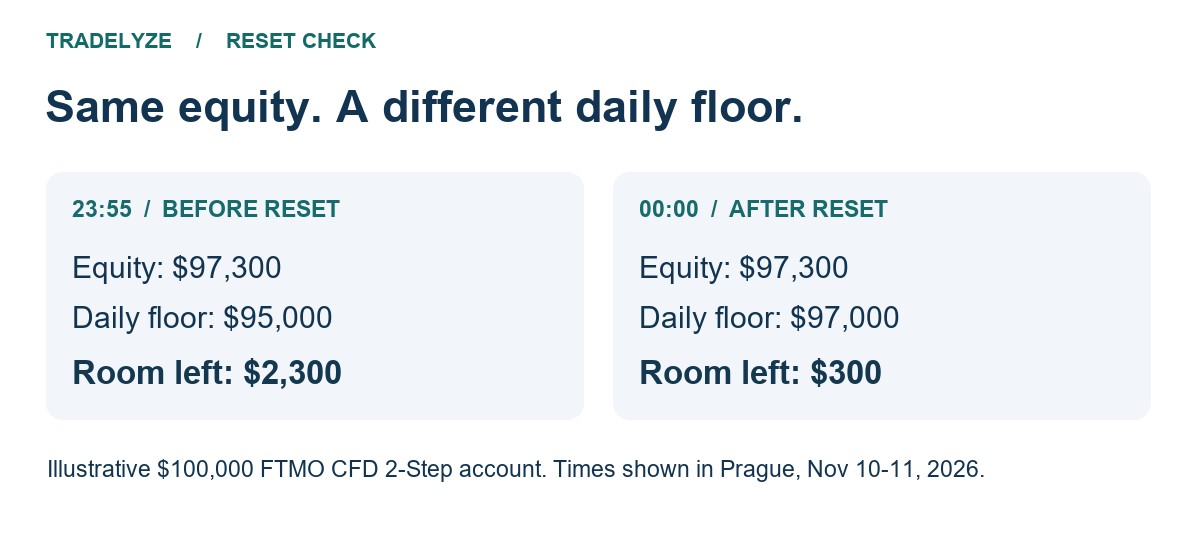
The account didn’t lose $2,000 at midnight. Its equity stayed at $97,300; its floor rose by $2,000. Closing B at the same price moves the loss from open P&L into balance without creating a fresh allowance. If B had instead fallen another $350 after midnight, equity would have reached $96,950, or $50 below that day’s floor. A later recovery wouldn’t erase the breach.
Notice another trap: both trades closed on November 10 in UTC, but on different trading days in Prague. Grouping the two exits by their UTC date produces a daily result of −$2,700. That number alone tells you neither the applicable floor nor how close the account came to it.
Does hitting the daily loss limit always fail the account?
No. Topstep describes its Daily Loss Limit as optional for the Trading Combine and Express Funded Account. When an applicable limit triggers, Topstep flattens positions, cancels pending orders and blocks new trades until the next session. Hitting that limit alone is a session lockout, not a rule violation. Its Maximum Loss Limit is a separate rule. Topstep’s Daily Loss Limit guide explains the distinction.
Don’t apply the FTMO overnight example to a Topstep futures position. On its regular trading schedule, Topstep requires positions to be closed by 3:10 p.m. CT, earlier for some products. The regular weekday reopen is 5 p.m. CT; after Friday’s close it’s normally Sunday at 5 p.m. Check the holiday schedule for the session you’re reviewing.
How to check a daily loss limit against your trade history
- Find the rule for your exact account. Write down the stage, allowance, balance used to set the floor, reset time, and what happens if you hit it. For a quick reference, see the Tradelyze daily loss limit glossary.
- Convert timestamps before assigning trades to days. Keep the original UTC timestamp and add a second column in the rule’s timezone, such as
Europe/PragueorAmerica/Chicago. In the November example, Prague midnight is 23:00 UTC the previous day; during European summer time it’s 22:00 UTC. Don’t apply one offset to a year of trades. - Rebuild equity on both sides of the reset. Use the balance, open P&L and costs at each observation. If commissions have already been booked into balance, don’t subtract them again. Compare equity with the floor that was in effect at that instant.
- Mark gaps in the evidence. Two closing fills can’t tell you the lowest equity while a position was open. If all you have is a list of closed trades, record the intraday result as unknown. A timestamped equity series or the firm’s risk log can help establish what happened between exits.
Once you know the remaining daily room, compare it with the separate overall drawdown buffer. The smaller constraint may be the one that matters for the next decision. The Tradelyze position-sizing example shows how to use those two numbers without mistaking buying power for money available to lose.




One Comment