

Trading Days vs Winning Days: What Counts at Prop Firms?
A five-day trading history can contain five active days, four profitable days and only two days that meet a particular profit threshold. Those counts answer different questions. A backtest that reports one of them does not automatically establish the others.
Minimum trading days usually describe an activity requirement. Winning-day requirements add a result definition, which may include a net profit threshold. The exact terms, account stage and day boundary determine how to count either one.
The practical approach is to build a day ledger from your trades before comparing its count with a requirement. This article uses a constructed ledger; the named rule example was checked on 12 October 2026.
Give each counter its own definition
Start with the firm’s wording rather than a label in your analytics software. Does an active day require an opened position, a closed trade, or another event? Does a winning day mean any positive result or at least a specified net amount? Are costs included? Which cycle is being measured?
Write a sentence that a second person could apply without guessing. For example: “For this hypothetical worksheet, a trading day has at least one opened position, and a qualifying winning day has at least $100 of daily net profit.” These are example definitions, not an industry standard.
Keep three columns even if the account only requires one: activity, daily net result and qualifying-day status. The additional columns make errors visible. A zero-result day can be active without being profitable; a small positive day may fail a larger qualifying threshold.
The broader rule-to-metric guide explains why a reported metric needs to match the rule it is intended to assess.
A five-day ledger with three different answers
Assume the following five hypothetical sessions each contain a newly opened and closed position. Results already include assumed trading costs. Under our example definition, a net result of at least $100 qualifies as a winning day.
| Session | Daily net result | Active? | Positive? | At least $100? |
|---|---|---|---|---|
| Monday | +$120 | Yes | Yes | Yes |
| Tuesday | +$40 | Yes | Yes | No |
| Wednesday | −$70 | Yes | No | No |
| Thursday | +$180 | Yes | Yes | Yes |
| Friday | +$95 | Yes | Yes | No |
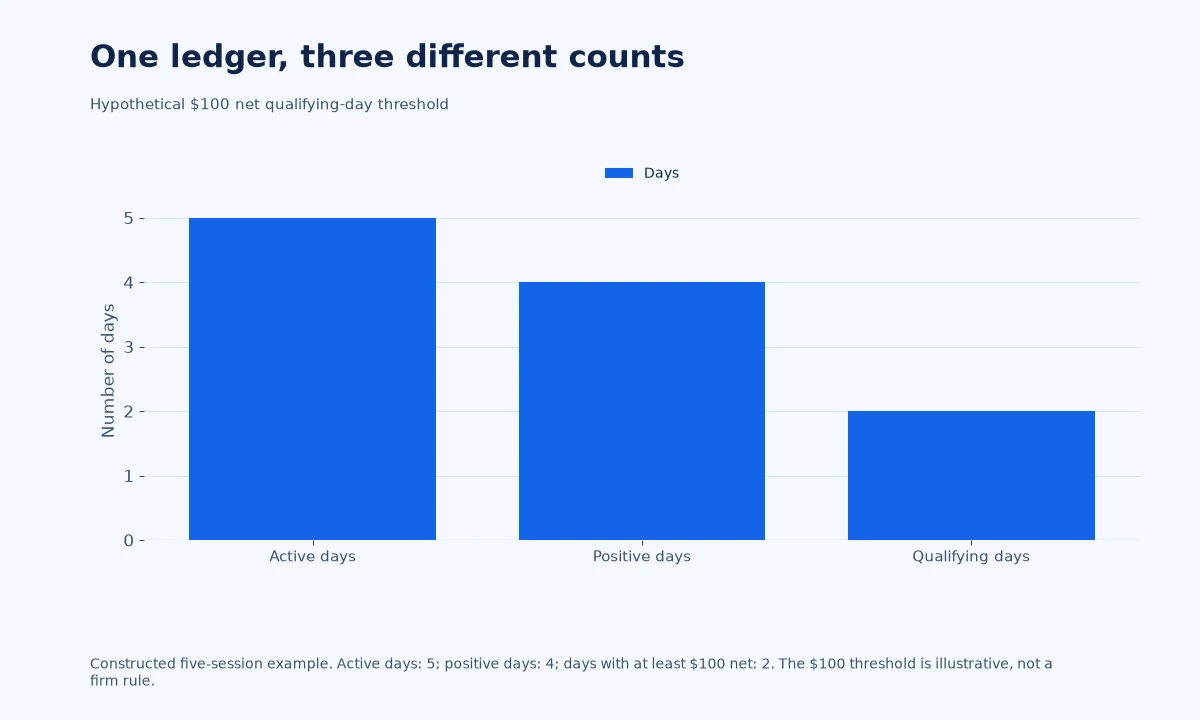
The totals are five active days, four positive days and two qualifying days. Combined net profit is $365. None of these figures substitutes for another. Changing the threshold changes the qualifying count without changing the trades or total profit.
Friday is the useful boundary case. It misses the example threshold by $5 even though it made money. If the result had been shown gross before costs, it might have appeared to qualify. That is why the worksheet should use the same cost treatment as the rule.
This ledger illustrates counting only. It does not establish that the account survived drawdown checks, met consistency requirements or was eligible for a payout.
Account paths can require different day counts
Topstep’s current payout policy provides a concrete example: its Express Funded Account Standard path requires five winning days of at least $150 net, whereas the XFA Consistency path specifies three trading days with at least one trade per day alongside its consistency condition. These are different paths, not alternative definitions to choose after seeing your results.
The same policy states that counts restart after a payout and excludes the payout-request trading day from the next count. Check the current policy and your selected path before applying the example. Other eligibility conditions still apply.
A day-count worksheet should therefore include the account path and cycle identifier. Without them, a long backtest can accidentally combine qualifying days from several cycles or stages into a count that no actual account would recognise.
Avoid a single lifetime total if the rule resets. Keep a separate tally for each cycle and preserve the event that starts the next one. This makes a disputed count much easier to investigate.
Opening date and closing date may disagree
Consider a position opened late on Monday and closed early on Tuesday. An opening-based activity rule can credit Monday. A closing-based report can assign its result to Tuesday. Both records may be internally consistent while measuring different things.
Retain entry and exit timestamps even if your first worksheet needs only one. Convert them using a documented timezone and session boundary. Do not group by your computer’s local calendar date merely because it is the default in a spreadsheet.
Tradelyze’s custom rules guide says its day grouping uses closed trades and the strategy’s exchange timezone. Check that convention against the firm’s definition before treating the displayed count as equivalent.
For positions crossing a reset, also inspect open P&L separately. The date used for an activity counter does not establish how equity is measured for a loss rule. See daily loss limits and reset times for that separate calculation.
Do not redesign trades merely to fill a calendar
A count requirement can tempt a trader to add a small trade on a quiet day or stay in the market until a threshold is reached. Either choice changes the tested behaviour. The additional trade has costs and risk even when the intended profit is small.
If your normal strategy produces infrequent signals, measure how long it took to satisfy the requirement across several fixed historical windows. Record windows that never completed it. A slower but rule-consistent schedule is more informative than an invented daily trade added outside the strategy.
If you decide to test an activity rule or a different daily stopping policy, define it before reviewing its results and create a new version. Do not quietly splice discretionary trades into a systematic report.
Use the validation workflow to preserve the distinction between developing a change and testing it on unseen data. The goal is an honest estimate of historical eligibility under stated assumptions, not a counter made green by editing definitions.
A compact review before trusting the number
Check the first and last day manually. Then check a losing day, a day just below the threshold and a trade crossing the session boundary. Finally, confirm that no row from the previous cycle has been included. These targeted checks find mistakes that a correct-looking total can hide.
Save the ledger with its source trades and written definitions. If the firm’s dashboard disagrees, compare individual days rather than arguing from a grand total. The discrepancy may come from costs, timestamps, a reset event or a different qualifying action.
Common questions
Is every profitable day a winning day?
Only if that matches the account’s definition. Some requirements use a minimum net profit threshold. A small positive result can count as profitable in your journal without meeting the firm’s qualifying threshold.
Do five trades mean five trading days?
No. Several trades can belong to the same defined day. Count distinct qualifying sessions or dates using the firm’s required activity and timezone, rather than counting individual trades.
Can I add winning days from before a payout?
Use the policy for that account and cycle. If the counter resets, earlier days cannot be carried into the new requirement. Keep payout events in the ledger so the measurement window is explicit.